10 °C Is Not 10 °C – Why Thermal Boundary Conditions Determine How Fast Your Battery Ages
In battery aging tests, the climate chamber is typically set to a fixed temperature and cells run through hundreds of charge and discharge cycles. Sounds comparable. But often it is not.
The same ambient temperature can lead to vastly different cell aging, depending on how the thermal boundary condition is set up during the test.
The Problem: Chamber Temperature Is Not Cell Temperature
The reasoning is straightforward. When a lithium-ion cell is charged at high current, it generates heat. How much of that heat stays inside the cell and how much is immediately dissipated depends on the thermal boundary condition: Is the cell actively cooled? Does it sit in an insulated housing? Is it exposed to airflow?
We investigated exactly this phenomenon on Samsung INR 18650-25R cells under three clearly defined scenarios, all at an ambient temperature of 10 °C:
- Passive cooling – the cell sits in an aluminium block that slowly absorbs the generated heat by conduction and releases it with a delay.
- Convection cooling – heat is removed by air circulation inside the climate chamber.
- Isothermal cooling – a water cooling plate keeps the cell surface strictly at ~10 °C.
The cells were charged using a CCCV protocol at 2C (5 A) to 4.2 V, followed by a constant voltage phase until the cut-off current was reached. After a 30-minute rest, they were discharged at 1C to the lower cut-off voltage of 2.5 V, followed by another 30-minute rest before the next cycle began.
The Results: Dramatic Differences After Just 200 Cycles
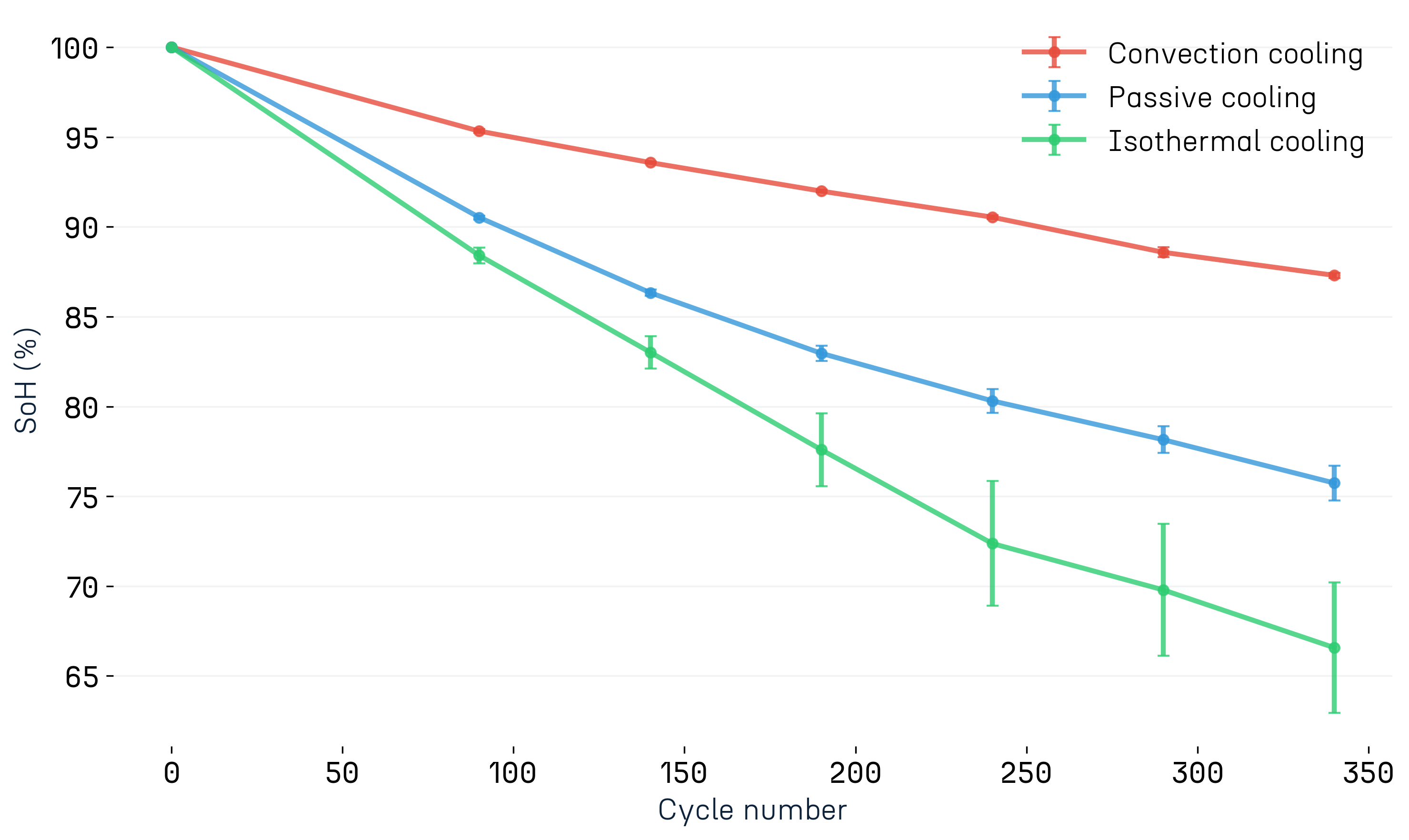
The outcome is sobering and revealing. After 200 cycles, the picture looked like this:
| Scenario | Capacity loss after 200 cycles |
|---|---|
| Convection cooling | < 10 % |
| Passive cooling | ~17.1 % |
| Isothermal cooling | > 22 % |
The isothermally cooled cells (those kept at a constant 10 °C) aged more than twice as fast as the cells under convection conditions. And this despite all groups running at exactly the same ambient temperature.
Why Does This Happen? The Lithium Plating Problem
The key lies in an effect known as lithium plating. During fast charging, especially at low temperatures, lithium ions cannot be intercalated into the graphite anode quickly enough. Instead, they deposit as metallic lithium on the anode surface, a process that is usually irreversible, causes lasting damage to the cell, and significantly accelerates capacity loss.
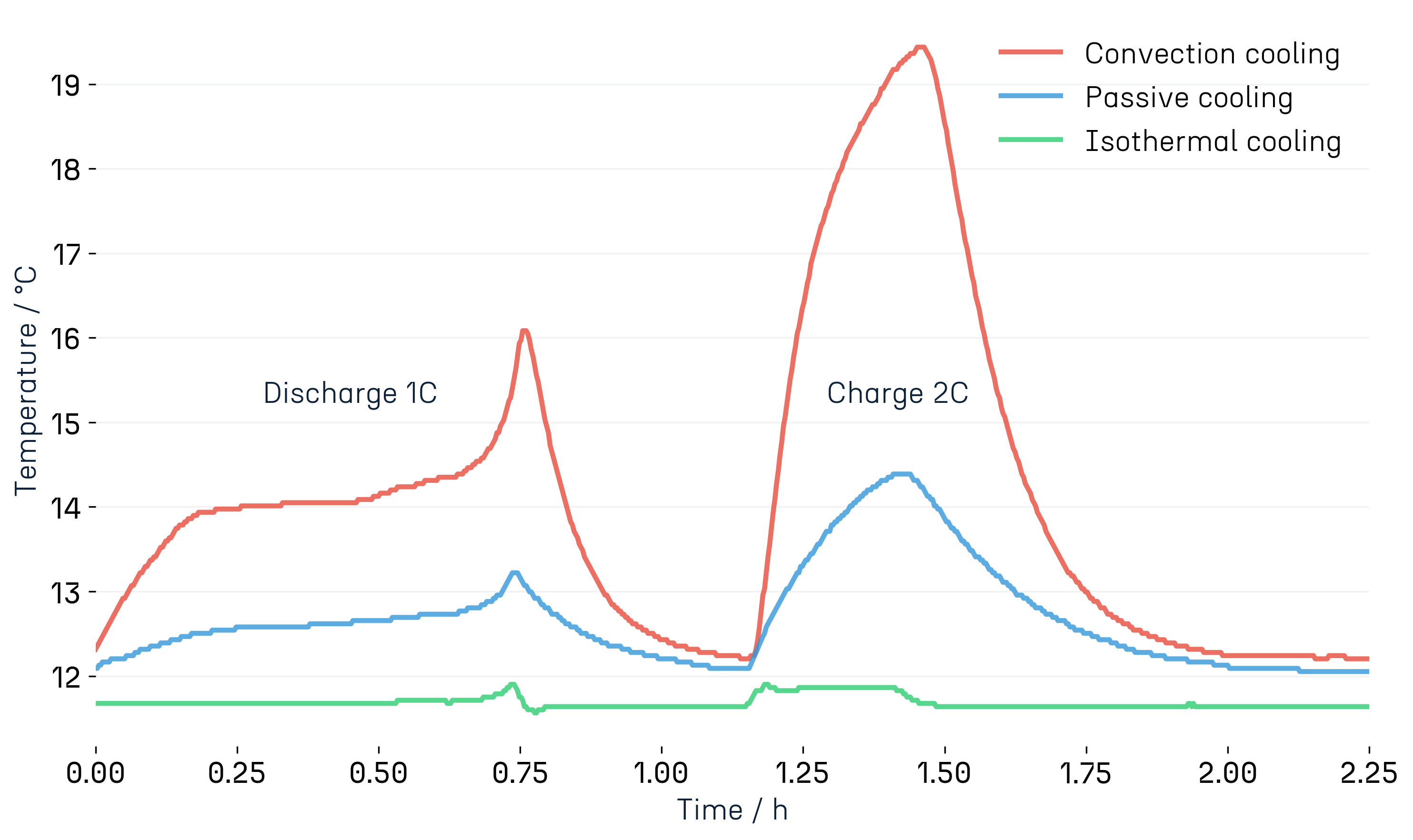
The intercalation rate increases with temperature. This is precisely where self-heating provides a decisive advantage: when the cell is allowed to warm from 10 °C to 18–20 °C during charging, electrochemical kinetics improve considerably — electrolyte conductivity, charge transfer, ion diffusion. The risk of lithium plating drops noticeably.
This is reflected clearly in the measured temperature profiles.
Implications for Testing
What does this mean for battery testing in general? Results from many published studies are difficult to compare directly, because the thermal boundary condition during aging is rarely identical. Some labs use climate chambers with air circulation, others rely on cooling plates or passive fixtures, as is common with pouch or prismatic cells.
There is another layer to this: even within the same climate chamber, the position of a cell can already make a difference of several degrees. Variations in airflow speed, depending on whether a cell is placed close to the fan or in a low-flow corner lead to different heat dissipation rates and therefore different temperature profiles during cycling. Two nominally identical tests in the same device can thus produce systematically different aging results.
On top of that, lab data often translates only partially to real-world behaviour: in actual systems, cells are thermally coupled to neighbouring cells and a housing, and are frequently actively cooled, conditions that need to be deliberately replicated in the lab.
Conclusion: Thermal Boundary Conditions Belong in the Test Protocol
The results suggest that thermal boundary conditions are not a minor detail in aging and performance testing, regardless of whether the application is electric vehicles, power tools, or electric aircraft. Anyone looking to meaningfully interpret test results and transfer them to a real application should define these conditions deliberately and document them in the test protocol.